- June 15, 2026
- 0 Comments
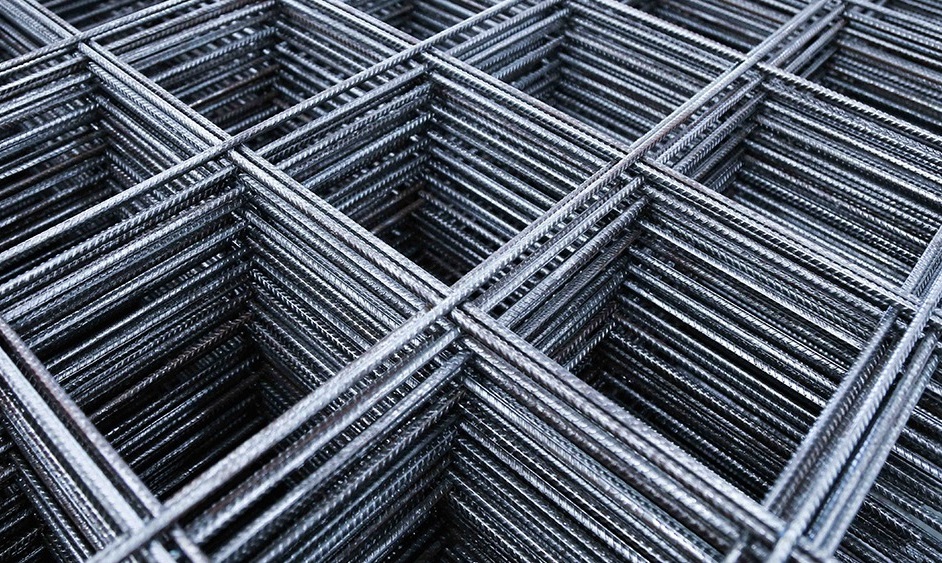
Every contractor, site engineer, and procurement manager working on a concrete project in the UAE has dealt with BRC mesh. It is on the reinforcement schedule of almost every residential slab, ground floor, podium deck, and boundary wall in Dubai and across the Emirates. Yet when it comes to specifying or ordering the right grade, a surprising number of procurement teams default to asking “just give me the standard mesh” without fully understanding what the grades mean, how the sizes differ, and which specification actually suits the project at hand.
This guide covers everything you need to know about BRC mesh specifications for UAE construction, from grade designations and wire diameters to sheet weights and standard applications. Whether you are a structural engineer checking a reinforcement schedule, a contractor pricing a concrete package, or a procurement manager placing a supply order, this is the reference you need in one place.
What Is BRC Mesh and Why Is It Called That in the UAE?
BRC mesh is the local and regional term used across the UAE, GCC, and broader Middle East for welded wire mesh used in concrete reinforcement. The name comes from the British Reinforced Concrete Engineering Company, which was among the earliest manufacturers of welded wire fabric for structural use. While the company name has long since evolved, the term “BRC mesh” stuck across markets where British construction standards and influence shaped the industry, including the UAE.
You will also hear it referred to as BRC fabric, steel fabric, welded wire fabric, or simply reinforcement mesh on UAE project sites. All of these terms refer to the same product: a prefabricated grid of high-yield steel wires welded at every intersection, supplied in flat sheets ready for direct placement in concrete formwork.
BRC mesh in the UAE is produced to BS 4483 (welded steel fabric for concrete reinforcement) using high-yield cold-drawn wire manufactured to BS 4482. At AL Jessour Steel, our welded wire mesh (BRC mesh) is manufactured to these standards with minimum yield strength of 500 N/mm², making it suitable for the full range of UAE structural applications.
BRC Mesh Grade Designations Explained
The grade system used for BRC mesh in the UAE follows the BS 4483 designation format. Each grade is identified by a letter and number, where the letter indicates the mesh type and the number represents the cross-sectional area of steel per metre width in square millimetres (mm²/m).
The letter designations work as follows:
A grades are square mesh, meaning the wire spacing and diameter are the same in both the longitudinal and transverse directions. These are the most common grades used for general slab reinforcement in the UAE.
B grades are structural mesh, with heavier longitudinal wires and lighter transverse wires. These are used for one-way spanning slabs, retaining walls, and situations where the primary reinforcement runs in one direction.
C grades are long mesh, with a very high ratio between longitudinal and transverse wire areas. These are used for road slabs and ground-bearing applications.
D grades are wrapping mesh, with very light wire sizes. These are used for encasing structural elements and wrapping applications.
For the vast majority of UAE building construction, you will be working with A grades. B grades appear on certain structural elements specified by the consultant. C and D grades are less common in building projects but appear on infrastructure and civil works.
Standard BRC Mesh Grades and Full Specification Table
The table below gives the standard grades used in UAE construction with their wire diameters, spacing, sheet dimensions, and weight per sheet. These are the specifications your reinforcement schedule and procurement order should reference.
|
Grade |
Longitudinal Wire (mm) | Transverse Wire (mm) | Wire Spacing (mm) | Sheet Size (m) | Weight (kg/m²) |
|
A98 |
5.0 | 5.0 | 200 x 200 | 4.8 x 2.4 | 1.54 |
|
A142 |
6.0 |
6.0 | 200 x 200 | 4.8 x 2.4 |
2.22 |
|
A193 |
7.0 | 7.0 | 200 x 200 | 4.8 x 2.4 |
3.02 |
|
A252 |
8.0 | 8.0 | 200 x 200 | 4.8 x 2.4 |
3.95 |
|
A393 |
10.0 | 10.0 | 200 x 200 | 4.8 x 2.4 |
6.16 |
|
B196 |
7.0 | 5.0 | 100 x 200 | 4.8 x 2.4 |
3.05 |
|
B283 |
8.0 | 6.0 | 100 x 200 | 4.8 x 2.4 |
3.73 |
|
B385 |
9.0 | 7.0 | 100 x 200 | 4.8 x 2.4 |
4.53 |
|
B503 |
10.0 | 8.0 | 100 x 200 | 4.8 x 2.4 | 5.93 |
|
C283 |
6.0 | 2.5 | 100 x 400 | 4.8 x 2.4 |
2.61 |
|
C385 |
7.0 | 3.0 | 100 x 400 | 4.8 x 2.4 |
3.41 |
| C503 | 8.0 | 4.0 | 100 x 400 | 4.8 x 2.4 |
4.34 |
Standard sheet size across all grades is 4.8m x 2.4m, giving a usable area of approximately 11.52 m² per sheet. Some suppliers also offer sheets in 6.0m x 2.4m for larger pour areas where reducing the number of laps improves efficiency and reduces steel usage.
For applications that require wire diameters beyond the standard range or custom panel sizes, our engineered wire mesh is produced to project-specific configurations with wire sizes up to 12mm and custom sheet dimensions.
Which BRC Mesh Grade to Use — UAE Application Guide
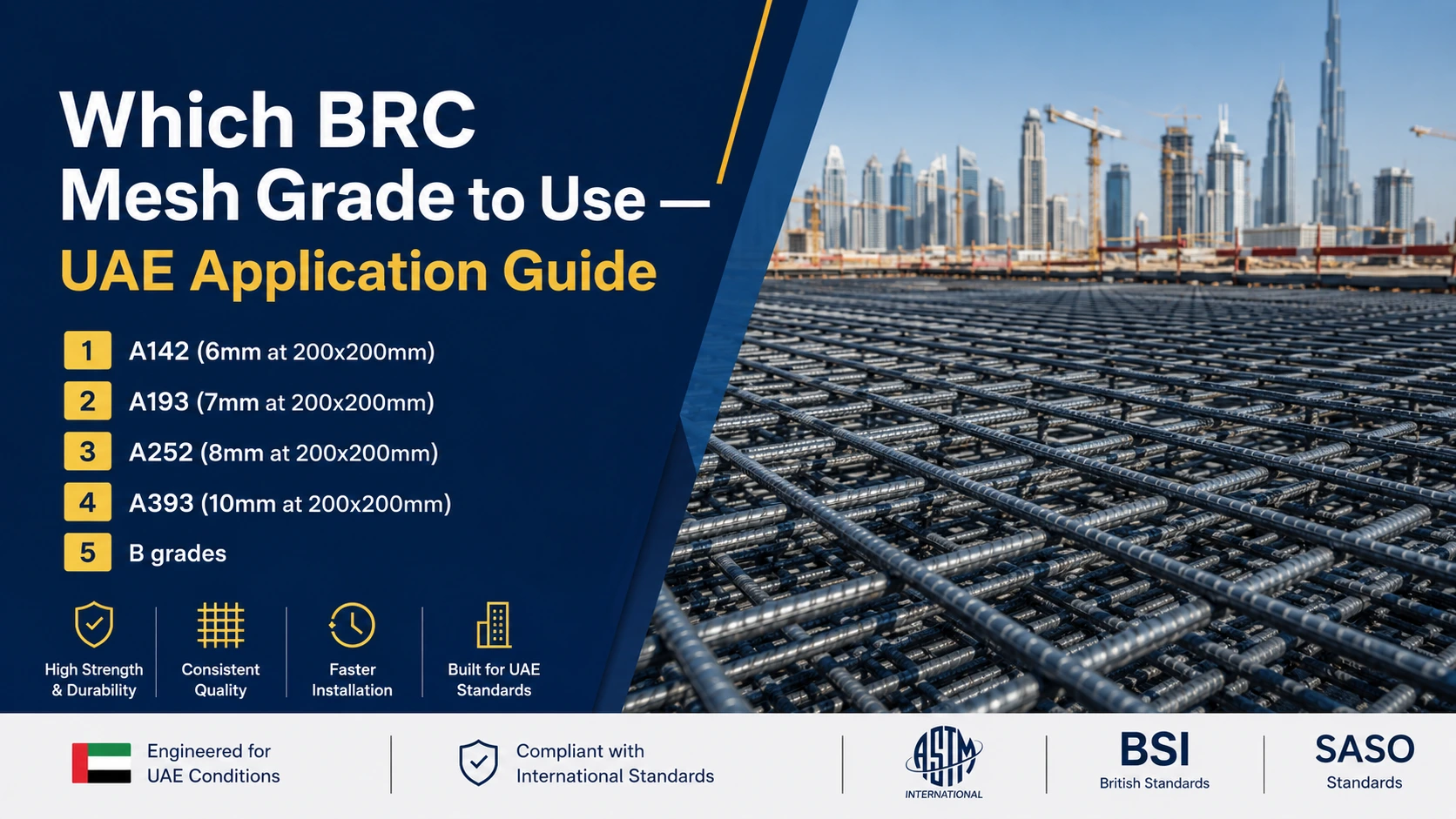
The most common source of procurement error on UAE sites is ordering a grade that does not match the structural engineer’s specification. The grade on the reinforcement drawing is not a suggestion, it is a structural requirement. That said, understanding the typical application range of each grade helps site teams catch specification errors early.
1. A142 (6mm at 200x200mm) is the lightest structural grade widely used in UAE construction. It is specified for lightly loaded ground floor slabs in residential villas, boundary walls, and pathways. If your structural drawings show A142, the slab is a light-duty application. Do not substitute a lighter grade and do not assume it is suitable for any suspended slab or floor carrying significant loading without consulting the engineer.
2. A193 (7mm at 200x200mm) sits between A142 and A252 and is used for moderately loaded ground slabs, external paving, and some precast wall panels. It is less commonly specified than A142 or A252 but appears regularly in UAE residential and light commercial projects.
3. A252 (8mm at 200x200mm) is one of the most commonly specified grades on UAE residential and commercial projects. It is used for ground-bearing slabs in mid-range residential buildings, podium slabs, and general floor construction. Most standard residential villa and low-rise apartment ground floor slabs in Dubai are specified at A252.
4. A393 (10mm at 200x200mm) is the heaviest standard square mesh grade and is used for heavily loaded ground slabs, industrial floors, warehouse floors, and some transfer slabs. If your project has heavy plant, forklift traffic, racking systems, or point loads from structural columns, A393 or an engineered mesh solution is the typical starting point. Our reinforcement mesh guide for modern UAE projects covers how heavier grades are applied across different project types in more detail.
5. B grades are used when the structural engineer has designed a one-way spanning system. On retaining walls, staircase waist slabs, and certain beam-and-slab configurations, B385 or B503 is commonly specified with the heavier longitudinal wires running in the spanning direction. Always check which direction the longitudinal wires should run before installation, as placing a B-grade sheet in the wrong orientation defeats the structural purpose entirely. This is one of the most common reinforcement mistakes on UAE construction sites.
BRC Mesh Laps and Cover Requirements in UAE Construction
Two practical details that procurement teams and site engineers frequently get wrong are lap lengths and concrete cover requirements.
For BRC mesh laps, the minimum overlap between adjacent sheets is 300mm in both directions for standard structural applications under BS 8110 and Eurocode 2, which are the design codes most commonly used by UAE consultancies. Some project specifications increase this to 400mm or one mesh pitch plus 150mm, depending on the grade and slab design. Always check the structural drawings for the specified lap length before laying mesh.
On cover, the concrete cover to BRC mesh in UAE construction must account for the aggressive exposure conditions common in the region, particularly the high sulphate content in UAE soils and the coastal salinity in projects near the shoreline. For ground-bearing slabs in direct contact with the ground, a minimum cover of 40mm to 75mm is typical depending on the exposure class. Mesh chairs and spacers are not optional, they are a structural requirement. Mesh resting on the ground or displaced during the pour will not perform as designed.
For projects where exposure conditions are severe, such as basement slabs, marine structures, or coastal infrastructure, understanding the right steel specification for sustainable and durable infrastructure is an important part of the material selection process.
H2: Ordering BRC Mesh in Dubai — What to Tell Your Supplier
When placing a BRC mesh order in Dubai, provide your supplier with the following information to ensure you receive the right material with the right documentation:
Grade designation (e.g. A252, A393, B385). Sheet size required (standard 4.8×2.4m or custom). Quantity in sheets or tonnes. Required standard (BS 4483). Mill certificate requirement (request EN 10204 3.1 as a minimum for all structural projects). Project name and delivery schedule.
Never order BRC mesh purely by wire diameter and spacing without referencing the grade designation. “8mm at 200×200” describes A252 in square mesh terms but does not specify whether you need standard or structural orientation, and it creates ambiguity if the supplier interprets it differently.
If your reinforcement schedule calls for a configuration not covered by the standard grades above, you need custom or engineered mesh rather than a standard BRC grade. Our team at AL Jessour Steel can review your reinforcement schedule and advise on the right product and configuration for your project.
BRC Mesh vs Engineered Mesh — When to Upgrade
Standard BRC mesh grades cover the majority of UAE construction requirements. However, there are project scenarios where the standard grade range is not sufficient and engineered or custom mesh is the correct specification.
If your structural drawings call for wire diameters above 10mm, spacings tighter than 200x200mm, panel sizes larger than the standard sheet, or a configuration not listed in the standard grade table, you are looking at an engineered mesh requirement. Engineered mesh is also the right choice for precast concrete production, where panels must match mould dimensions precisely, and for heavily reinforced transfer slabs and raft foundations where standard grades do not provide the required steel area per metre.
Understanding the difference between standard BRC and custom steel mesh for modern construction helps project teams make the right call at the specification stage rather than discovering the problem during procurement or on site.
Our engineered wire mesh and welded wire mesh (BRC mesh) are both manufactured at our Dubai facility to certified standards. View our full product range or contact our technical team to discuss your project specification.

Frequently Asked Questions
1. What does the number in a BRC mesh grade mean?
The number in a BRC mesh grade designation (A142, A252, A393, etc.) represents the cross-sectional area of steel in square millimetres per metre width of mesh. A393 provides 393 mm²/m of steel area, A252 provides 252 mm²/m, and so on. This figure is what the structural engineer uses to calculate whether the mesh provides sufficient reinforcement for the design load.
2. What is the most common BRC mesh used in UAE residential construction?
A252 (8mm wire at 200x200mm spacing) is the most frequently specified grade for general residential slab construction in the UAE. A142 is used for lighter applications such as pathways and boundary walls, while A393 is used for heavier-loaded slabs and industrial floors.
3. Can I substitute A393 for A252 if A252 is out of stock?
You can only substitute a grade with written approval from the structural engineer. A393 provides more steel area than specified, which means higher material cost, but more critically it changes the structural and thermal performance assumptions in the design. Always submit a formal material substitution request before changing any specified grade.
4. What standard is BRC mesh manufactured to in the UAE?
BRC mesh in the UAE is produced to BS 4483 (specification for welded steel fabric for concrete reinforcement), using wire manufactured to BS 4482. This is consistent with the British-influenced design codes used by most UAE engineering consultancies. Understanding how these standards relate to each other is covered in our guide on reinforcement steel standards for UAE construction.
5. What is the weight of a standard A252 BRC mesh sheet?
A standard A252 mesh sheet (4.8m x 2.4m) weighs approximately 45.5 kg per sheet (3.95 kg/m² x 11.52 m²). This figure is important for logistics planning, lifting equipment requirements on site, and transport load calculations when ordering in bulk.