- July 20, 2026
- 0 Comments
Ask ten contractors in the UAE what they pay for fabricated reinforcement steel and you will get ten different answers. Not because anyone is being quoted unfairly, but because “steel fabrication cost” is not a single number. It is a stack of costs: raw material, processing, wastage, logistics, certification and payment terms. Every project moves those numbers in a different direction.
At AL Jessour Steel Industries, we quote reinforcement steel every working day for projects across Dubai, Abu Dhabi, Sharjah and the Northern Emirates. This guide opens up our pricing logic so you can read any quotation in the market with confidence, challenge the right line items, and stop comparing numbers that were never comparable in the first place.
The Three Layers of a Steel Fabrication Price
Every quotation you receive, from us or anyone else, is built from three layers.
Layer one: the material. This is the steel itself, priced per metric tonne. It tracks global billet and scrap markets, and it is the layer nobody in the region fully controls. When billet moves, every mill in the Gulf moves with it, usually within weeks.
Layer two: the processing. Cutting, bending, mesh welding, bundling, tagging. This is charged either as an addition per tonne or built into an all-in rate. It is where suppliers genuinely differ, because it reflects plant efficiency rather than commodity markets.
Layer three: the delivery and service. Transport to site, crane-off, phased deliveries, documentation, mill test certificates, and the cost of holding stock for you. On a tight urban site with no laydown area, this layer can quietly become the most expensive part of the job.
A quote that looks cheap on layer one and vague on layers two and three is not a cheap quote. It is an incomplete one.
What Actually Moves the Price Up or Down
Grade and standard
The specification you build to has a direct cost consequence. Steel supplied to different international standards carries different chemistry, testing and certification burdens, and those flow into the rate. We cover the practical differences in our guide to BS 4449 vs ASTM A615 reinforcement steel standards, and we recommend reading it before you finalise a specification, because switching standards mid-project is one of the more expensive corrections a team can make.
Diameter mix
Small-diameter bars cost more per tonne to produce and to process than large ones. A slab-heavy project loaded with 10 mm and 12 mm bar will carry a higher blended rate than a foundation package dominated by 25 mm and 32 mm bar. When you compare two quotes, compare the diameter mix behind them, not just the headline rate.
Product form: bar, mesh or coil
This is where a lot of confusion enters the market, so let us be precise about it.
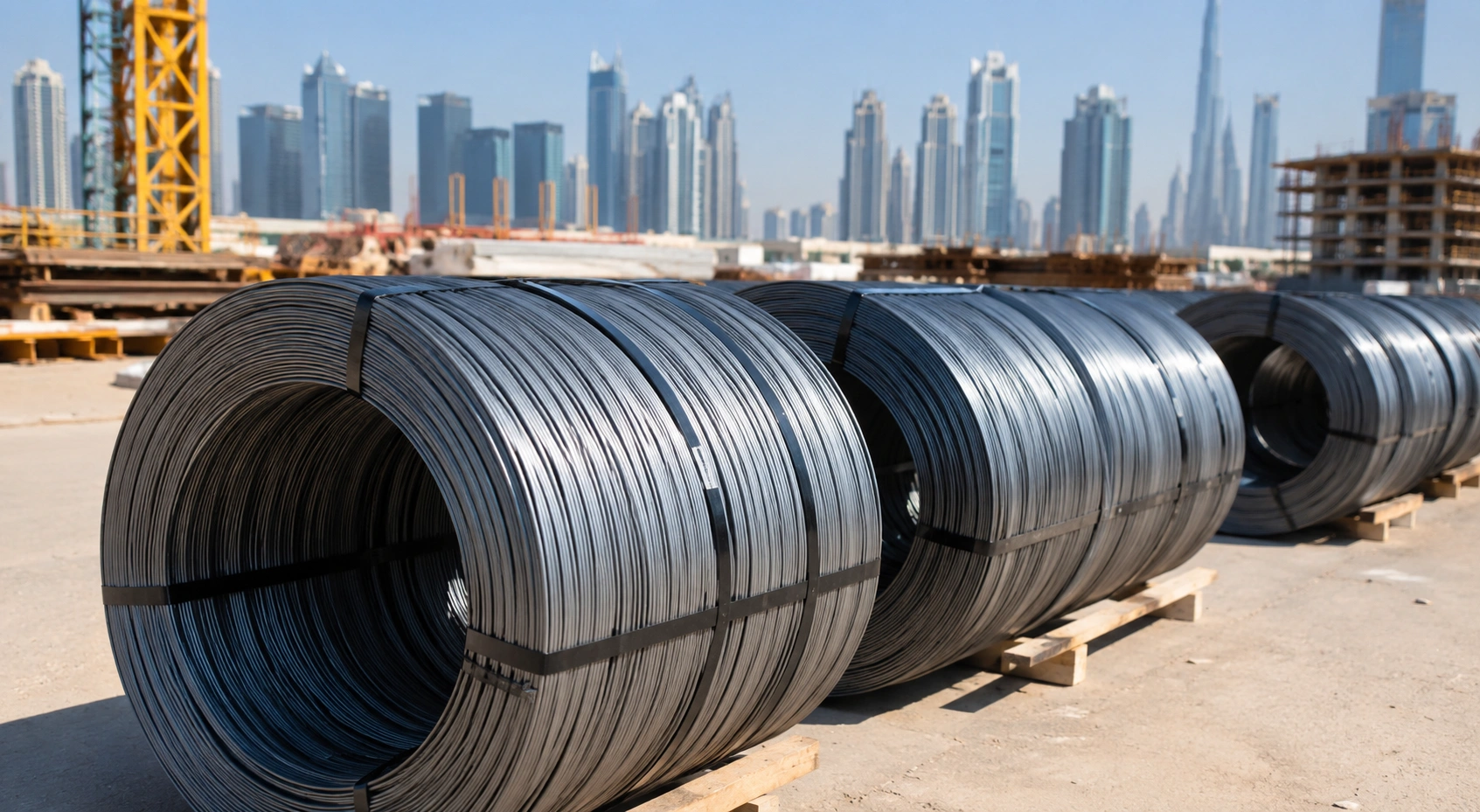
Contractors on site primarily use rebar, straight-length or cut-and-bent bars, as their working reinforcement product. Welded wire mesh is the second major site product, supplied in standard sheets or in bespoke configurations, and it can dramatically reduce fixing labour on slabs and screeds. Compact coils, meanwhile, are not a contractor product in normal practice. They are a manufacturing input: coils are fed into mesh welding lines to produce welded wire mesh. Understanding this distinction matters commercially, because coil pricing behaves like a raw-material price while mesh pricing behaves like a finished-product price, and confusing the two makes quotations impossible to compare.
If mesh is a significant part of your package, our guides to BRC mesh sizes and specifications for UAE construction and custom steel mesh for modern construction in Dubai will help you specify accurately before you request numbers.
Cut and bend versus straight length
Straight-length bar has the lower headline rate. Cut and bend has the lower total cost on most projects, because it removes offcut waste, removes bar-bending labour and plant from your site, and removes the storage area you would otherwise need. Site cutting typically wastes somewhere between five and ten percent of the steel you paid for, and that waste is paid at the full rate. On a thousand-tonne package, that is not a rounding error.
Order volume and call-off structure
A single consolidated order priced against a locked material position will always beat a series of small emergency orders placed at spot. If you can give us a programme, we can give you a rate that reflects it. Phased call-offs against one agreed price are the single most effective cost-control tool available to a UAE contractor, and they cost nothing to arrange.
Delivery location and site constraints
Fujairah is not Dubai Marina. A yard with open access and a forklift is not a podium slab with a two-hour night window. Transport distance, permitted delivery hours, offloading method and bundle size all carry real cost, and honest suppliers price them openly rather than burying them.
Payment terms
Credit is not free. A ninety-day quote and a cash-against-documents quote for the same steel are different products. When a rate looks unusually strong, check the terms attached to it before you celebrate.
Where Projects Lose Money Without Noticing
In our experience, most cost overruns on reinforcement packages are not caused by the rate. They are caused by rework, waste and delay.
Wrong bar mark quantities force reorders at spot pricing. Late bar bending schedules compress fabrication windows and push work into premium slots. Poor site storage in coastal humidity leaves bar with surface degradation that a consultant may reject. Over-ordering to be safe leaves tonnes of surplus that nobody buys back at the price you paid.
We wrote about these patterns in detail in our article on common reinforcement steel mistakes in the UAE, and we would encourage every procurement and site team to read it before the first pour rather than after the first rejection.
Sustainability and Cost: No Longer Opposites
There is a persistent assumption that responsibly produced steel carries a premium. In the UAE, that assumption is increasingly outdated. Regional production leans heavily on electric arc furnace routes fed by recycled scrap, which is both the lower-carbon route and, structurally, a competitive one. We explain the process in our piece on recycling in modern steel production.
Where sustainability genuinely affects your commercials is on the compliance side. Green building credits, client ESG reporting and public-sector infrastructure requirements increasingly ask for documented material provenance. Supplying that documentation is not expensive, but retrofitting it after the fact, or substituting material to satisfy it late, absolutely is. Our articles on choosing the right steel for modern construction and eco-steel and the future of green construction standards set out what clients are now asking for.
How to Compare Quotes Properly
Before you place them side by side, normalise them. Ask every supplier for the same six things:
- Rate per metric tonne, with the standard and grade stated
- Whether cut and bend is included, excluded, or charged separately
- The diameter mix the rate assumes
- Delivery terms, to site, offloaded, in how many drops
- Validity period of the price
- Payment terms and any documentary requirements
Once those six are aligned, comparison becomes honest. Until they are, you are guessing.
Getting a Reliable Number for Your Project
The fastest route to an accurate price is to send us your bar bending schedule, or your drawings if the schedule is not ready, along with your programme, delivery location and required standard. From that, we can return a firm quotation rather than an indicative rate, and an indicative rate, on a reinforcement package, is worth very little.
We would rather give you a number you can build a budget on than a number that wins a comparison spreadsheet and then moves.
Frequently Asked Questions
1. Is steel priced per tonne or per metre in the UAE?
Reinforcement steel is priced per metric tonne. Per-metre figures are sometimes quoted for convenience on small orders, but they are always derived from a tonnage rate and a unit weight, so ask for the underlying tonnage price when you compare.
2. Does cut and bend cost more than straight-length bar?
The rate is higher, but the delivered project cost is usually lower. Cut and bend removes offcut waste, site bending labour, plant hire and storage requirements. On most packages the saving outweighs the processing charge comfortably.
3. How long is a steel quotation valid in the UAE?
Validity varies with market conditions. In stable periods, a few weeks is common; in volatile periods, quotes may be valid for days. Always check the validity date, and consider locking a price against a call-off schedule if your programme is long.
4. Why do two suppliers quote such different prices for the same steel?
Usually because the quotes are not for the same thing. Differences in standard, diameter mix, processing inclusion, delivery terms and payment terms can easily account for a large spread without either supplier being out of the market.
5. Are compact coils cheaper than rebar?
They are a different product with a different purpose, so the comparison is not meaningful for a contractor. Coils are a manufacturing input used to produce welded wire mesh, while contractors buy rebar and finished mesh. Compare rebar to rebar and mesh to mesh.
6. Does using recycled or eco-steel increase my costs?
Not materially in the UAE, where much regional production already uses electric arc furnace routes fed by recycled scrap. The cost risk sits in documentation and late specification changes, not in the material itself.
7. What information do you need to give me a firm price?
A bar bending schedule or drawings, the required standard and grade, total tonnage, delivery location, programme or call-off dates, and your payment terms. With those, we can issue a firm quotation rather than an indicative one.
8. Can I fix a price for a project that runs over several months?
In many cases yes, through an agreed call-off arrangement against a defined tonnage and programme. Talk to us early, the longer the visibility you can give, the more certainty we can offer in return.